Medical Equipment
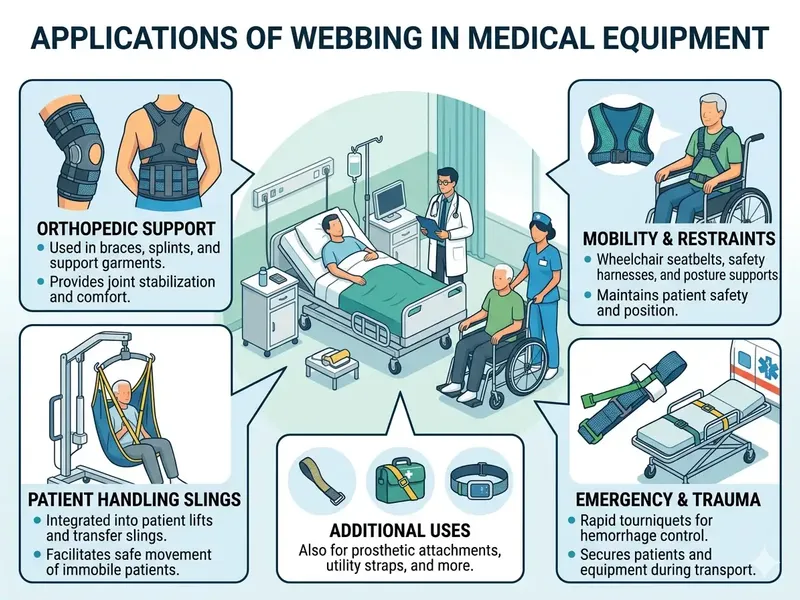
Application Image
Medical Equipment
Application Overview
2 products available for this application.
Medical Equipment Products
Explore our webbing products engineered for medical equipment applications. Click any product for detailed technical specifications.
 Excellent EW-HD-001
 Heavy Duty Elastic Webbing
High-strength elastic webbing designed for safety, orthopedic and industrial support applications.
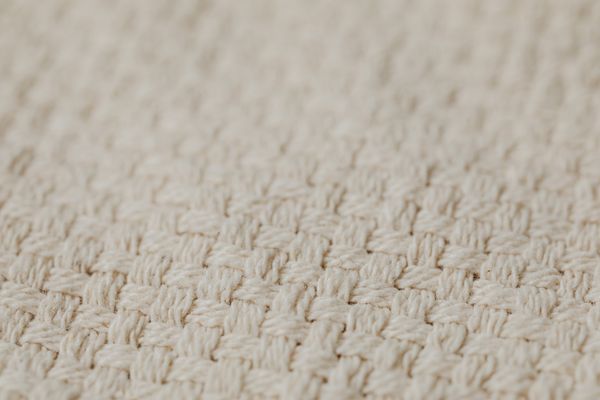
Eco-Friendly CW-NT-002 Natural Cotton Webbing
Eco-friendly natural cotton webbing with soft texture and sustainable appeal.
Technical Details
Detailed description and specifications for Medical Equipment.
Overview
Medical equipment webbing is a functional textile component used across patient-handling, immobilization, and support applications within hospitals, clinics, rehabilitation centers, and home-care settings. Because these products come into direct or near-direct contact with patients and staff, webbing must combine mechanical reliability with skin-safe, hygienic properties that tolerate repeated cleaning and sterilization. The right webbing balances softness and comfort against the load-bearing and durability demands of straps, restraints, slings, braces, and mounting systems.
Key Requirements & Specifications
- Tensile / breaking strength: General-purpose medical straps typically require 600–1,200 lbs (2.7–5.3 kN) breaking strength, while patient-lift slings and transfer straps demand 2,000–5,000 lbs (8.9–22.2 kN) with a working load safety factor of 5:1 or higher.
- Width: Common finished widths range from 20mm, 25mm, 38mm, and 50mm for straps and restraints, up to 75mm–100mm for load-spreading lift slings that reduce localized pressure on the body.
- Thickness: Standard woven medical webbing runs 1.0mm–2.5mm; elastic knitted constructions run 0.8mm–1.6mm depending on stretch ratio and yarn density.
- Elongation: Elastic medical webbing generally provides 80%–150% stretch at rated load, while rigid support webbing is held below 10% elongation to maintain positional stability.
- Abrasion resistance: Minimum 15,000–20,000 cycles (Martindale or comparable) to withstand repeated repositioning, buckle friction, and cleaning contact.
- Temperature range: Serviceable from -20°C to +80°C for standard use; autoclave-compatible constructions must tolerate steam sterilization at 121°C–134°C without significant loss of tensile strength or dimensional stability.
- Biocompatibility / hygiene: Skin-contact webbing should use OEKO-TEX Standard 100 certified yarns, be free of azo dyes and harmful substances, and resist bacterial and fungal growth; antimicrobial finishes are available on request.
- Colorfastness and cleanability: Grade 4–5 colorfastness to washing and rubbing so straps retain appearance and do not transfer dye after repeated disinfection with alcohol or chlorine-based agents.
Recommended Webbing Solutions
Knitted Elastic Webbing: Provides consistent, multidirectional stretch with soft recovery, making it suitable for adjustable braces, limb supports, and compression straps where the product must flex with patient movement while maintaining tension. Its knitted structure gives a smoother edge and lower abrasion against skin than woven elastics.
Heavy Duty Elastic Webbing: Combines elasticity with higher load capacity, engineered for patient positioning straps, gurney and stretcher restraints, and dynamic support systems that must stretch under load yet return reliably to shape without permanent deformation.
Soft Cotton Webbing: A natural-fiber option valued for breathability and low skin irritation, appropriate for direct-contact straps, ties, and support bands where comfort and reduced allergic response are priorities. Cotton absorbs moisture and feels gentle against prolonged skin contact.
Natural Cotton Webbing: An undyed or minimally processed cotton construction well suited to applications requiring minimal chemical content and maximum skin compatibility, such as pediatric supports, sensitive-skin restraints, and reusable cloth-based fittings that undergo frequent laundering.
Applications & Use Cases
- Patient transfer and lift slings: Wide load-spreading webbing (75mm–100mm) distributes body weight across the torso and thighs during mechanical lifting, using high-tensile constructions rated at 2,000 lbs or more with a 5:1 safety factor.
- Bed, gurney, and wheelchair restraints: Adjustable straps in 25mm–50mm widths secure patients during transport and procedures, requiring quick-release compatibility, cleanable surfaces, and reliable buckle retention.
- Orthopedic braces and limb supports: Knitted elastic webbing in 20mm–50mm widths provides adjustable compression and support for post-surgical and rehabilitation devices, flexing with movement while holding position.
- Immobilization and positioning aids: Rigid, low-stretch straps hold limbs or the body in fixed alignment during imaging, surgery preparation, or radiation therapy where positional accuracy is critical.
- Medical equipment mounting and organization: Durable straps secure oxygen tanks, monitors, IV poles, and cabling to beds, carts, and mobile equipment, using abrasion-resistant webbing that tolerates frequent adjustment.
- Home-care and mobility aids: Comfortable cotton and elastic straps serve walkers, transfer belts, gait belts, and supportive garments used daily by patients and caregivers outside clinical settings.
Customization & Wholesale
WebbingMaker supplies medical-grade webbing to global wholesale and bulk buyers with customization across construction, dimensions, and finishing.
Minimum order quantity: Standard MOQ is 500m per specification for stock constructions and colors. Custom-woven or custom-dyed runs typically start at 3,000m–5,000m per color/specification to justify loom setup and dye-lot minimums. Sampling quantities of 10m–50m are available for evaluation and qualification prior to bulk commitment.
Custom widths and thickness: Available in any width from 10mm to 100mm, with custom thickness and elongation profiles tuned to the target application. Both woven and knitted elastic constructions can be produced to buyer specification.
Colors and printing: Custom color matching to Pantone/TPX references is supported, along with silicone anti-slip coatings, edge finishing, and printing for logos, sizing marks, batch codes, or directional indicators. Reflective and antimicrobial treatments are available on request.
Materials: Standard offerings include polyester, nylon, cotton, and blended elastic yarns. OEKO-TEX Standard 100 certified and low-chemical-content yarn options are available for skin-contact and sensitive applications, along with autoclave-compatible fiber selections for sterilizable products.
OEM and ODM: Full private-label service including custom weave patterns, proprietary color and finish combinations, buyer-branded packaging, and cut-and-sew semi-finished components such as pre-cut straps with sewn ends or attached hardware.
Lead time: Stock items typically ship within 7–10 days of order confirmation. Custom production runs generally require 20–30 days depending on quantity, dyeing, and finishing requirements. Sample lead time is typically 5–7 days.
Export capabilities: WebbingMaker exports worldwide with experience serving buyers across North America, Europe, the Middle East, Southeast Asia, and Oceania. Shipping options include FOB, CIF, and door-to-door arrangements by sea and air freight, with support for standard export documentation, certificates of conformity, and material test reports. Packaging is provided on rolls, spools, or in cut lengths per buyer specification, with export-grade cartons and moisture protection for long-distance transit.
For medical applications, buyers are advised to specify the intended use, required breaking strength, sterilization method, and any regulatory or certification requirements at the quotation stage so that construction, yarn selection, and finishing can be matched to the performance and compliance targets of the finished device.
Need Medical Equipment Solutions?
Our engineering team can develop custom webbing solutions for your specific medical equipment requirements.
Request a Technical Quote