Tactical Gear
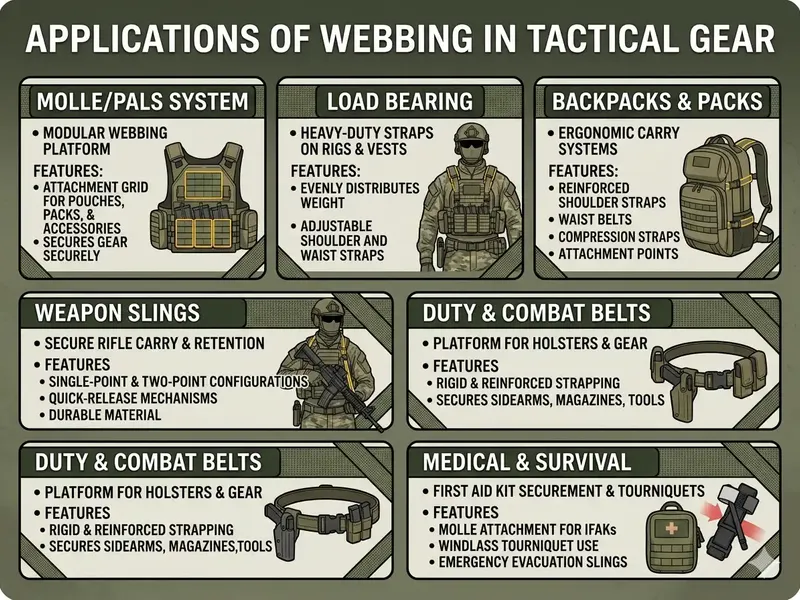
Application Image
Tactical Gear
Application Overview
4 products available for this application.
Tactical Gear Products
Explore our webbing products engineered for tactical gear applications. Click any product for detailed technical specifications.
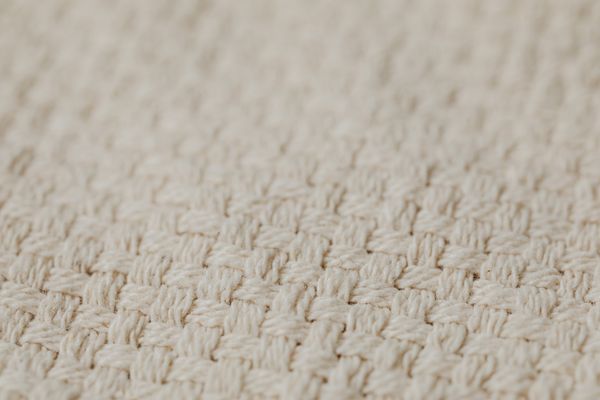 Military Grade AW-MS-003
 Military Aramid Webbing
Military-grade aramid webbing for tactical systems, load-bearing equipment and defense applications.
Military Grade NW-MS-001 Mil-Spec Nylon Webbing
Military-grade nylon webbing engineered for tactical equipment, load-bearing systems and defense applications.
Significant UW-TC-003 UHMWPE Tactical Webbing
Military-grade UHMWPE webbing for tactical equipment and mission-critical load-bearing systems.
MIL-SPEC Level JW-TC-006 Tactical Jacquard Webbing
Military-grade jacquard webbing designed for tactical equipment, gear systems and defense applications.
Technical Details
Detailed description and specifications for Tactical Gear.
Overview
Tactical gear webbing forms the structural backbone of load-bearing equipment used in military, law enforcement, and professional outdoor applications. It must sustain repeated high-stress loading, resist cutting and abrasion in field conditions, and retain dimensional stability across temperature and moisture extremes without failure. Because tactical systems such as plate carriers, MOLLE platforms, slings, and harnesses carry mission-critical loads and often life-safety weight, the webbing's tensile integrity, edge stability, and consistency directly determine the reliability of the finished gear.
Key Requirements & Specifications
- Tensile / breaking strength: Core load-bearing webbing typically rates from 4,000 lbs (17.8 kN) for standard MOLLE and utility straps up to 8,000 lbs (35.6 kN) for harness, sling, and rigging applications; aramid and UHMWPE constructions can exceed 9,000 lbs (40 kN) at reduced weight.
- Width: Common tactical widths are 25mm (1"), 38mm (1.5"), and 50mm (2"), with 19mm (0.75") and 44mm (1.73") available for specialized MOLLE spacing and sling hardware compatibility.
- Thickness: Ranges from 1.2mm to 2.0mm depending on fiber and weave density; MOLLE-grade nylon is generally 1.3mm to 1.5mm to balance stiffness with pass-through workability.
- Abrasion resistance: Rated to withstand 10,000+ cycles under Wyzenbeek-type testing for high-denier nylon and UHMWPE, ensuring minimal surface degradation against gear, rock, and hardware contact.
- Cut resistance: Aramid and UHMWPE fibers provide substantially higher cut and shear resistance than standard nylon, critical for edge-exposed straps and rescue applications.
- UV resistance: Solution-dyed and UV-stabilized constructions retain 80% or more of original tensile strength after 500+ hours of accelerated UV exposure, limiting field degradation.
- Temperature range: Nylon and UHMWPE perform reliably from -40°C to +80°C; aramid webbing extends thermal tolerance to approximately +250°C continuous, with short-term resistance to flame and higher spikes.
- Elongation: Nylon offers 20% to 30% elongation for shock absorption in dynamic loading, while UHMWPE and aramid stay under 5% for low-stretch, high-stability load control.
- Colorfastness: Rated 4 to 5 on the grey scale for wash and rub fastness, supporting IR-compliant and MIL-STD color matching for coyote, ranger green, black, and multicam palettes.
Recommended Webbing Solutions
Military Aramid Webbing (Aramid Webbing category): Engineered for extreme thermal and cut-resistant environments, aramid webbing withstands continuous temperatures near 250°C and offers high strength-to-weight performance, making it suited to flame-exposed straps, heat-adjacent equipment, and applications where cut resistance is non-negotiable.
Mil-Spec Nylon Webbing (Nylon Webbing category): Manufactured to MIL-W-17337 and MIL-W-43668-type specifications, this webbing delivers a proven balance of tensile strength, controlled elongation for shock absorption, and abrasion resistance, making it the standard choice for MOLLE panels, load-bearing straps, and general-purpose tactical assemblies.
UHMWPE Tactical Webbing (UHMWPE Webbing category): Ultra-high-molecular-weight polyethylene provides the highest strength-to-weight ratio with minimal stretch and excellent cut and abrasion resistance, ideal for lightweight slings, rigging, and load-critical straps where reducing carried weight is a priority.
Tactical Jacquard Webbing (Jacquard Webbing category): Woven with integrated logos, unit identifiers, or patterns directly into the structure rather than printed on, jacquard webbing maintains full load-bearing capability while supporting branding, identification, and OEM customization requirements without surface wear.
Applications & Use Cases
- MOLLE / PALS platforms: 25mm and 38mm nylon webbing rows are stitched to plate carriers, vests, and packs to create modular attachment grids, requiring precise width tolerance and stiffness so pouches thread and lock reliably under load.
- Rifle and equipment slings: Two-point and single-point slings use 25mm to 38mm nylon or UHMWPE webbing rated 4,000 lbs or higher, balancing shock absorption, adjustability, and weight for sustained shoulder loading.
- Load-bearing harnesses and belts: Duty belts, chest rigs, and rappel harnesses rely on 44mm and 50mm high-tensile webbing (up to 8,000 lbs) where breaking strength and edge stability are life-safety factors.
- Rescue and rigging systems: UHMWPE and aramid webbing serve in anchor slings, extraction straps, and hauling systems where low stretch, cut resistance, and high breaking strength are essential under dynamic and static loads.
- Heat- and flame-exposed assemblies: Aramid webbing is used in applications adjacent to engines, exhaust, or fire environments, retaining strength where nylon would soften or fail above +80°C.
- Pack compression and cargo restraint: 25mm to 50mm nylon webbing forms compression straps, cargo tie-downs, and drag handles, requiring abrasion resistance and colorfast finishing for prolonged field exposure.
Customization & Wholesale
Minimum order quantity: Standard MOQ is 500m per specification for stock constructions, with custom-engineered weaves, fibers, or colorways typically starting at 1,000m to 3,000m depending on complexity and fiber sourcing.
Custom widths: Available from 10mm to 100mm, with tolerance held to industry-standard limits for hardware and MOLLE compatibility; non-standard widths can be tooled to buyer specification.
Colors and matching: Solution-dyed and piece-dyed options in standard tactical palettes (black, coyote brown, ranger green, olive drab, multicam-compatible tones) with Pantone or MIL-STD color matching and IR-signature-compliant dyeing available on request.
Printing and weaving: Jacquard woven-in patterns, logos, and unit markings are supported for durability, alongside silk-screen and heat-transfer printing for lower-volume identification runs.
OEM and ODM: Full private-label manufacturing is available, including custom fiber blends, weave density, edge finishing, cut-and-sew-ready spooling, and buyer-specified packaging and labeling.
Lead time: Sampling typically runs 7 to 15 days; bulk production lead time is generally 15 to 30 days after sample approval, subject to order volume, fiber availability, and finishing requirements.
Export capabilities: Established export operations serve North America, Europe, the Middle East, Southeast Asia, and Oceania, with support for FOB, CIF, and EXW terms, standard export documentation, and container consolidation for mixed-specification wholesale orders.
Quality assurance: Production is supported by tensile and breaking-strength testing, batch consistency checks, and compliance documentation aligned to relevant military and industrial webbing standards, with certificates of conformance available for qualifying orders.
Need Tactical Gear Solutions?
Our engineering team can develop custom webbing solutions for your specific tactical gear requirements.
Request a Technical Quote