Polyester webbing offers excellent dimensional stability and long-term durability for automotive restraint systems.
Overview: Why Polyester Webbing for Seat Belts Matters
The Backbone of Occupant Safety
Polyester webbing for seat belts is the load-bearing textile that restrains passengers during collision events, absorbing and distributing kinetic energy across the body. For global wholesale buyers in the Automotive Industry, selecting the correct webbing is not a commodity decision—it is a safety-critical specification.
Why Polyester Leads
- Low elongation (typically 8–12% at break) keeps occupants securely positioned during rapid deceleration.
- UV and abrasion resistance ensures a service life exceeding 10 years in harsh cabin environments.
- Dimensional stability under humidity and temperature swings from −40°C to +80°C.
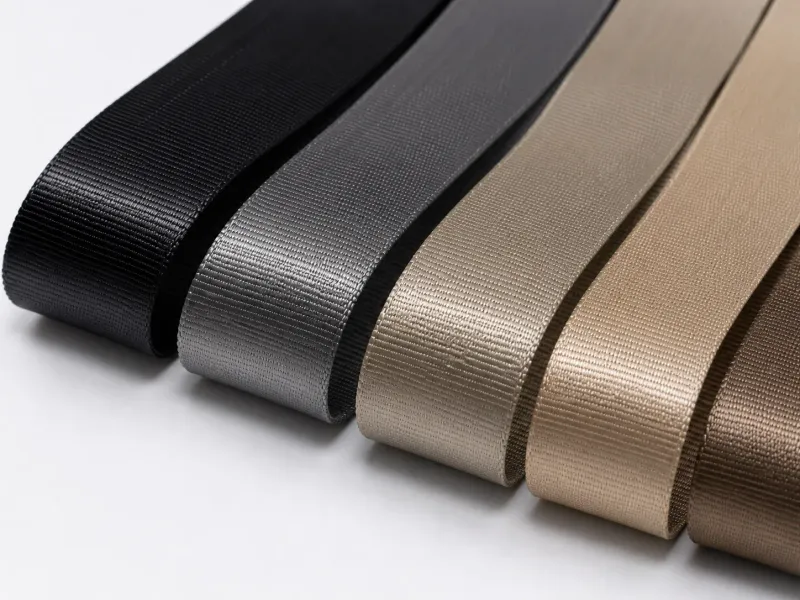
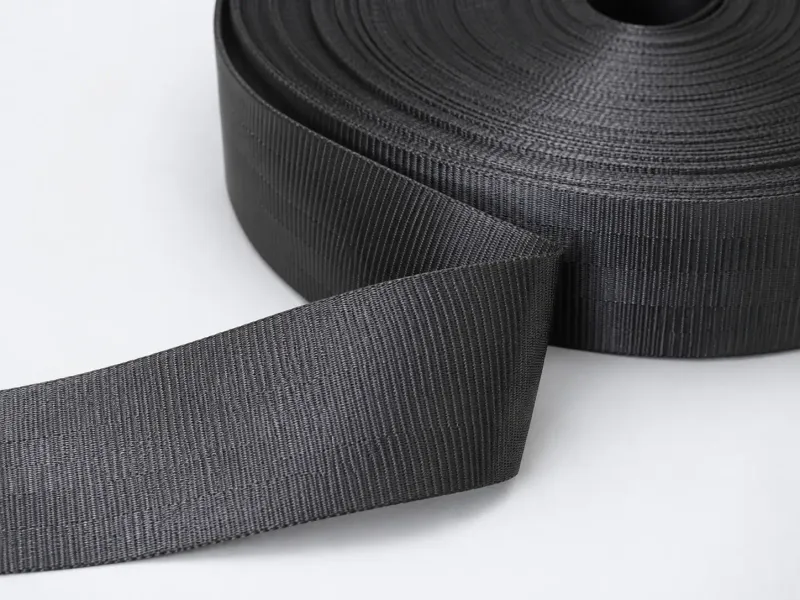
Compared to nylon, polyester offers superior resistance to moisture absorption and long-term stretch, which is why our Seat Belt Polyester Webbing is engineered specifically for restraint systems. For heavier restraint or industrial harness applications, Heavy Duty Polyester Webbing delivers higher breaking loads.
Buyer Takeaway
Bulk purchasers sourcing within the Polyester Webbing category should evaluate tensile strength, energy absorption, and compliance certification together. A webbing that merely "looks strong" but fails elongation limits can be non-compliant with international restraint standards, exposing OEMs and importers to recall and liability risk. Getting the base material right protects downstream brand reputation.
Key Specifications & Standards
Governing Standards
Polyester webbing for seat belts must meet strict regulatory benchmarks before it enters any restraint system. Core standards include FMVSS 209 (US), ECE R16 / EN standards (Europe), ISO 6487 for test measurement, and ASTM D6775 for webbing break strength testing.
Comparison Table
| Spec | Seat Belt Polyester Webbing | Heavy Duty Polyester Webbing |
| Standard width | **46–48 mm** | **50 mm** |
| Thickness | **1.1–1.2 mm** | **1.3–1.5 mm** |
| Breaking strength | **≥ 26.7 kN** | **≥ 30 kN** |
| Elongation at break | **8–12%** | **10–14%** |
| Weave | 2/2 twill | Reinforced twill |
| Standard color | Black / custom | Black / custom |
Compliance Notes
- FMVSS 209 requires a minimum breaking strength of 26.7 kN (6,000 lbf) for Type 1 assemblies.
- ECE R16 mandates controlled elongation between 4% and 30 kN load ranges depending on assembly type.
- Abrasion cycling per ISO 5470 confirms surface durability.
Buyers within the Polyester Webbing category should always request third-party test reports. For the Automotive Industry, documented traceability against ASTM and ISO methods is typically a purchase-order prerequisite, not an optional add-on.
Material & Construction Details
Fiber & Yarn Engineering
The performance of polyester webbing for seat belts starts at the yarn level. Our Seat Belt Polyester Webbing uses high-tenacity industrial polyester filament engineered for controlled stretch and energy absorption.
Core Features
- High-tenacity yarn rated at approximately 8.0–9.5 g/denier, delivering consistent load capacity.
- Yarn density of roughly 1,000–1,500 denier per strand for a tight, uniform weave.
- 2/2 twill weave construction that balances flexibility with resistance to fraying and edge unraveling.
- Breaking strength ≥ 26.7 kN, meeting global restraint thresholds.
- Elongation controlled to 8–12%, critical for occupant positioning during impact.
- Melting point around 250–260°C, providing thermal stability in hot cabins.
- Moisture regain below 0.4%, so strength does not degrade in humid climates.
Construction Advantages
For demanding restraint and lifting-adjacent uses, Heavy Duty Polyester Webbing increases thickness to 1.3–1.5 mm and breaking loads to ≥ 30 kN. Both products sit within the broader Polyester Webbing category and can be produced with sealed or ultrasonically cut edges to prevent fray. Consistent picks-per-inch and tension control during weaving ensure every roll meets the same dimensional tolerance, which is essential for automated retractor and buckle assembly lines.
Applications & Use Cases
Primary Application: Vehicle Restraint
The defining use case for polyester webbing for seat belts is the vehicle Seat Belt assembly—three-point, lap, and racing harness configurations across passenger cars, commercial trucks, and buses.
Where It Is Deployed
- Passenger vehicle three-point belts using Seat Belt Polyester Webbing at 46–48 mm width for standard retractor systems.
- Commercial and heavy-vehicle restraints where Heavy Duty Polyester Webbing provides higher ≥ 30 kN breaking loads for larger occupants and rugged duty cycles.
- Aftermarket and replacement belts supplied to the Automotive Industry repair and refit channel.
- Motorsport and off-road harnesses requiring low-elongation restraint under repeated high-G loading.
- Child restraint and booster systems where controlled elongation and edge integrity are safety-critical.
Adjacent Uses
Beyond the vehicle Seat Belt, the same Polyester Webbing category supports cargo restraint, wheelchair securement in accessible vehicles, and industrial safety harnesses. Because these applications share the need for consistent break strength and UV resistance, buyers often consolidate orders across restraint and securement lines. Standardizing on one qualified supplier for both Seat Belt Polyester Webbing and Heavy Duty Polyester Webbing simplifies certification management and inventory across an OEM's full product range.
Buying Guide & Wholesale Terms
Sourcing Polyester Webbing for Seat Belts
Procurement teams buying polyester webbing for seat belts in bulk should align on MOQ, customization, OEM support, and lead time before issuing a purchase order.
Wholesale Terms
| Term | Standard Offering |
| **MOQ** | **3,000–5,000 meters** per color/spec |
| **Lead time** | **15–30 days** after sample approval |
| **Sample lead time** | **5–7 days** |
| **Payment** | **30% deposit**, balance before shipment |
| **Packaging** | Rolls of **100–200 m**, moisture-protected |
Customization & OEM
- Width options from 25 mm to 50 mm, covering both Seat Belt Polyester Webbing and Heavy Duty Polyester Webbing.
- Custom colors with ±0.5 mm width tolerance and Pantone matching available.
- OEM/ODM service: private branding, logo jacquard weaving, and spec-to-print manufacturing.
- Certification support with test reports against FMVSS 209, ISO, and ASTM methods.
Buyer Recommendations
Request pre-production samples and third-party break-strength verification before committing to full-container volumes. For the Automotive Industry, confirm that your supplier can maintain lot-to-lot consistency across the Polyester Webbing category at scale. Locking in documented tolerances up front prevents costly assembly-line rejections and keeps restraint components fully compliant across export markets.
Frequently Asked Questions
What is the minimum order quantity (MOQ) for polyester webbing used in seat belts?
Our standard MOQ for polyester seat belt webbing is 500 meters per specification, which keeps sampling and trial orders accessible for most B2B buyers. For custom colors, weave patterns, or specialized load ratings, the same 500-meter minimum typically applies per SKU. Larger production runs qualify for tiered pricing. If you need to validate performance before committing, we recommend ordering a 500-meter batch for internal testing and certification alignment first.
Can you customize the width and specifications of polyester seat belt webbing?
Yes. We offer OEM/ODM customization on polyester webbing with custom widths from 10mm to 100mm, plus adjustable thickness, tensile strength, weave density, and color matching to your Pantone references. Seat belt applications commonly use widths around 46-50mm, but we tool to your exact requirements. You can supply drawings, samples, or performance targets, and our engineering team will develop specifications and produce pre-production samples for your approval before full manufacturing.
Why choose polyester webbing over nylon for seat belt applications?
Polyester webbing offers lower elongation, excellent UV and abrasion resistance, and strong dimensional stability under load, making it well-suited for restraint applications. Nylon provides higher stretch and energy absorption, which some designs prefer. We manufacture both, along with polypropylene, elastic, cotton, aramid, and UHMWPE webbing, so we can advise based on your load ratings and regulatory targets. Share your performance requirements and we'll recommend the optimal material and construction.
Are your polyester webbing products certified, and what are your shipping terms?
Our manufacturing operates under an ISO 9001 quality management system, with consistent process controls and batch traceability to support your compliance and testing needs. We provide material documentation and can align production with buyer-specified standards. For shipping, we handle export orders worldwide via sea and air freight, supporting FOB and other common Incoterms. Lead times depend on order volume and customization; contact our team for a precise quotation and production schedule.
Related Resources
Related Products (2)
Related Categories
Related Applications
Related Industries
Automotive Grade Polyester Seat Belt Webbing
Contact Our Team