Backpack
Application Image
Backpack
Application Overview
4 products available for this application.
Backpack Products
Explore our webbing products engineered for backpack applications. Click any product for detailed technical specifications.
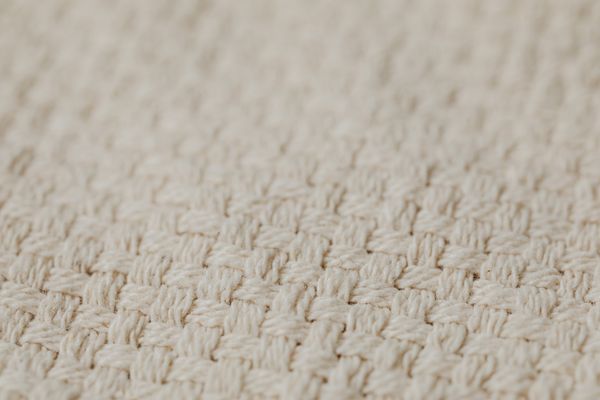 Load Bearing JW-BP-004
 Backpack Jacquard Webbing
High-strength jacquard webbing developed for backpacks, outdoor gear and travel products.
Military Grade NW-MS-001 Mil-Spec Nylon Webbing
Military-grade nylon webbing engineered for tactical equipment, load-bearing systems and defense applications.
Lightweight PPW-LG-004 Luggage Polypropylene Webbing
Durable polypropylene webbing for luggage straps, bag handles and travel accessories.
Ultra Soft CW-SF-005 Soft Cotton Webbing
Ultra-soft cotton webbing designed for pet products, apparel accessories and comfort-focused applications.
Technical Details
Detailed description and specifications for Backpack.
Overview
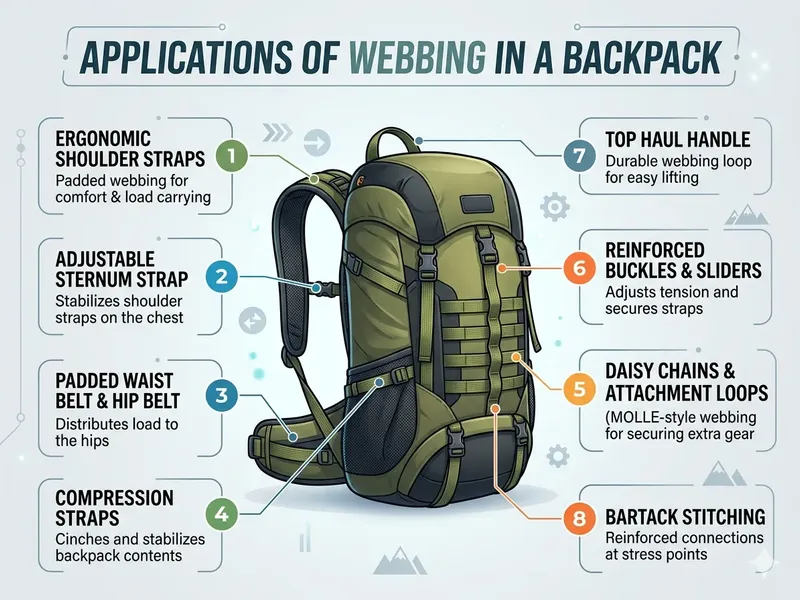
Backpack webbing forms the structural backbone of load-bearing straps, compression systems, and attachment points across daypacks, hiking packs, tactical rucksacks, and travel luggage. It carries and distributes weight across shoulder straps, sternum straps, hip belts, and MOLLE grids, meaning any failure translates directly into product returns and brand damage for the buyer. For this reason, backpack webbing must combine high tensile strength, consistent width tolerance, abrasion resistance, and dimensional stability under repeated flex and load cycling.
Key Requirements & Specifications
- Tensile / breaking strength: Shoulder-strap and hip-belt webbing typically requires 1,200 to 2,500 lbs (5.3 to 11.1 kN) minimum breaking strength; heavy-duty tactical and load-hauling webbing ranges from 4,000 to 8,000 lbs (17.8 to 35.6 kN). Standard 25mm nylon commonly rates around 1,500 lbs, while 50mm heavy nylon reaches 6,000 lbs and above.
- Width range: Standard backpack widths are 15mm, 20mm, 25mm, 38mm, and 50mm. 25mm (1 inch) is the most common for daypack straps and MOLLE; 38mm and 50mm are used for hip belts and main compression straps. Width tolerance should hold to ±0.5mm.
- Thickness: Typical range is 1.0mm to 2.2mm depending on construction. Lighter jacquard and PP webbing runs 1.0 to 1.4mm; heavy nylon load webbing runs 1.6 to 2.2mm for stiffness and buckle retention.
- Abrasion resistance: Nylon and polyester constructions should withstand 15,000 to 25,000 Martindale rub cycles (or equivalent Wyzenbeek testing) without significant surface degradation, critical for straps that contact zippers, buckles, and rough external surfaces.
- UV resistance: For packs exposed to sustained sunlight, webbing should retain a minimum of 80 percent of original tensile strength after 500 hours of accelerated UV exposure. Solution-dyed and UV-stabilized yarns are recommended for outdoor and expedition use.
- Temperature range: Functional performance from -40°C to +80°C. Nylon retains flexibility at low temperatures; polypropylene performs well in wet/cold conditions but softens above roughly 80°C, so PP is best reserved for lower-load applications.
- Elongation: Nylon elongates approximately 20 to 30 percent at break, providing shock absorption for dynamic loads; polyester elongates 12 to 18 percent for lower stretch where dimensional stability matters. Backpack straps generally favor controlled elongation of 15 to 25 percent.
- Colorfastness and finish: Minimum Grade 4 to 5 on the AATCC/ISO wash and rubbing scale, with low moisture absorption to prevent stretch, mildew, and weight gain in wet conditions.
Recommended Webbing Solutions
Backpack Jacquard Webbing (Jacquard Webbing category): Woven with raised or recessed patterns, logos, and brand names directly into the structure rather than printed on the surface. This suits brand-forward backpack lines that require durable, non-fading logo integration on shoulder straps and front panels, while still delivering functional strength for light to medium load-bearing straps.
Heavy Duty Nylon Webbing (Nylon Webbing category): The primary choice for load-bearing shoulder straps, hip belts, and compression straps due to its high tensile strength, abrasion resistance, controlled elongation, and shock-absorbing properties. Nylon's flexibility across a wide temperature range makes it suitable for hiking, tactical, and expedition packs where safety margins matter.
Luggage Polypropylene Webbing (Polypropylene Webbing category): A lightweight, cost-effective, and moisture-resistant option for travel luggage straps, internal organization webbing, and lower-load attachment points. PP does not absorb water and resists mildew, making it appropriate for budget-conscious bulk orders and non-critical straps where extreme tensile strength is not required.
Heavy Duty Cotton Webbing (Cotton Webbing category): Offers a soft hand feel and natural aesthetic favored in fashion, heritage, and casual backpack lines. It suits decorative straps, accents, and low-load applications where appearance and comfort against the body outweigh maximum tensile demands.
Applications & Use Cases
- Load-bearing shoulder straps: 25mm to 38mm heavy-duty nylon anchors the primary weight path from the top of the pack to the base. Controlled elongation absorbs dynamic shock during walking and running, reducing shoulder fatigue and stress on stitch points.
- Hip belts and waist straps: 38mm to 50mm nylon transfers pack weight to the hips on hiking and expedition packs. High breaking strength (4,000 lbs and above) and dimensional stability ensure the belt holds tension without creep under heavy loads.
- Compression and cinch straps: 20mm to 25mm nylon or polyester webbing reduces pack volume and stabilizes contents. Low stretch and reliable buckle retention keep loads secure over long transits.
- MOLLE / PALS attachment grids: 25mm webbing rows stitched at fixed intervals allow modular pouches and accessories on tactical and outdoor packs. Requires tight width tolerance and abrasion resistance for repeated threading and removal.
- Brand and logo straps: Jacquard webbing on sternum straps, front panels, and pull tabs delivers woven-in branding that resists fading and abrasion far better than printed alternatives, supporting premium product positioning.
- Travel luggage and daypack organization: Lightweight polypropylene webbing serves internal compression, laptop retention sleeves, and external accessory loops where moisture resistance and low cost are prioritized over maximum tensile strength.
Customization & Wholesale
Minimum order quantity: Standard MOQ is 500m per color and specification for stock constructions. Custom jacquard, specialty weaves, and bespoke color matching typically start at 3,000m to 5,000m per design to justify loom setup. Sample lengths of 1 to 5m are available for evaluation and testing prior to bulk commitment.
Custom widths: Available from 10mm up to 100mm, produced to buyer-specified widths with ±0.5mm tolerance. Common backpack widths (15mm, 20mm, 25mm, 38mm, 50mm) are held in ready stock for standard nylon and PP.
Custom colors: Full Pantone (TPX/TCX) color matching supported. Solution-dyed options are available for maximum UV and wash colorfastness, and piece-dyed options for shorter runs and faster turnaround. Grade 4 to 5 colorfastness is standard.
Custom printing and branding: Options include woven jacquard logos, silk-screen printing, heat-transfer printing, and reflective yarn integration. Jacquard is recommended for durability; printing is more economical for high color complexity and shorter runs.
OEM / ODM: Full OEM manufacturing to buyer drawings and specifications, including custom yarn selection (nylon 6, nylon 66, polyester, PP, cotton), construction density, edge finish, and stiffness. ODM support is available for buyers who need design and material recommendations to meet a target tensile rating, weight, or cost.
Material and specification control: Buyers can specify tensile rating, elongation, thickness, and finish. Test reports (breaking strength, colorfastness, abrasion) can be provided on request, and third-party lab testing (SGS, Intertek) can be arranged for compliance-sensitive markets.
Lead time: Sampling typically takes 7 to 15 days. Bulk production runs 15 to 30 days after sample and order confirmation, depending on quantity, dyeing requirements, and jacquard complexity. Reorders of stock specifications generally ship faster.
Export capabilities: Experienced in global wholesale export with FOB and CIF terms from major Chinese ports. Standard packaging is rolls on cardboard cores, bagged and boxed, with roll lengths customizable to buyer requirements (commonly 50m, 100m, or 200m per roll). Documentation support includes commercial invoice, packing list, and certificates of origin, with compliance available for REACH, RoHS, and OEKO-TEX standards on request.
Need Backpack Solutions?
Our engineering team can develop custom webbing solutions for your specific backpack requirements.
Request a Technical Quote