Climbing Equipment
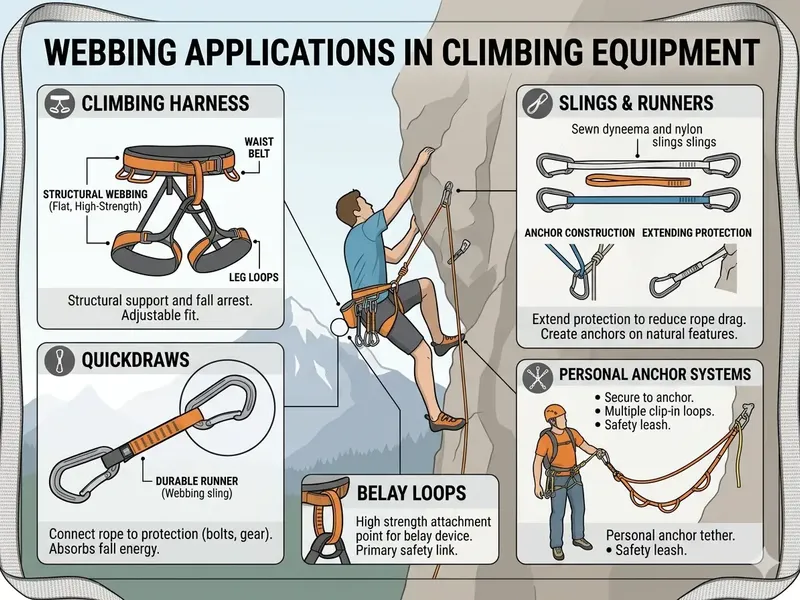
Application Image
Climbing Equipment
Application Overview
2 products available for this application.
Climbing Equipment Products
Explore our webbing products engineered for climbing equipment applications. Click any product for detailed technical specifications.
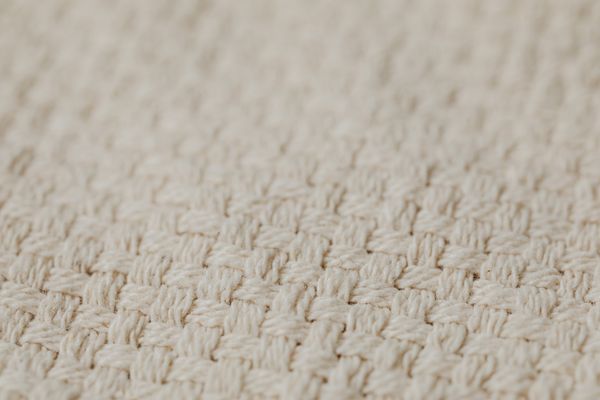 Minimal UW-CL-002
 UHMWPE Climbing Webbing
Lightweight UHMWPE webbing engineered for climbing, mountaineering and rescue equipment.
Excellent AW-CR-004 Cut Resistant Aramid Webbing
High-strength cut-resistant aramid webbing for industrial protection and safety equipment.
Technical Details
Detailed description and specifications for Climbing Equipment.
Overview
Climbing equipment webbing is engineered textile strapping used in load-bearing applications where failure carries direct safety consequences, including harnesses, slings, quickdraws, anchor systems, and rappelling setups. In these applications, webbing functions as a critical structural link that must reliably hold dynamic and static loads generated by a climber's weight, fall arrest forces, and equipment. Because climbing subjects webbing to repeated shock loading, abrasion against rock and hardware, and prolonged UV and moisture exposure, material selection and certified mechanical performance are non-negotiable for this end use.
Key Requirements & Specifications
- Tensile/breaking strength: Climbing webbing typically requires a minimum breaking strength of 22 kN (approximately 4,950 lbs) for individual slings, with heavy-duty and load-critical configurations rated to 30-36 kN (6,700-8,000 lbs) to maintain adequate safety margins.
- Width: Standard climbing widths range from 10mm to 25mm, with 16mm and 25mm being the most common for slings and runners; harness and anchor webbing often uses 25mm to 44mm for load distribution.
- Thickness: Typical thickness ranges from 1.0mm to 2.5mm depending on material and construction, balancing packability against strength and cut resistance.
- Low elongation: Static and semi-static climbing webbing should exhibit low working elongation, generally under 5% at rated load for anchor and rigging applications, to minimize shock transfer and system movement.
- Edge and abrasion resistance: Webbing must withstand repeated abrasion against rock, carabiners, and belay devices; tightly woven edges and high-tenacity fibers extend service life under cyclic edge loading.
- Cut resistance: For applications exposed to sharp rock edges or where redundancy is limited, cut-resistant fiber construction is specified to reduce the risk of edge-initiated failure.
- UV resistance: Fibers and any coatings should retain a high percentage of rated strength after prolonged UV exposure; UHMWPE and treated nylon are selected for outdoor longevity, though all synthetic webbing should be retired per usage guidelines.
- Temperature range: Operational stability is required across roughly -40°C to +80°C for nylon-based products; aramid webbing extends usable performance to 200°C+ for heat-adjacent or high-friction scenarios.
Recommended Webbing Solutions
UHMWPE Webbing (category): UHMWPE (ultra-high-molecular-weight polyethylene) offers an exceptional strength-to-weight ratio, low elongation, and strong abrasion and moisture resistance, making it well suited to lightweight slings and anchor material where high breaking strength and minimal bulk are priorities.
UHMWPE Climbing Webbing: This product delivers certified high tensile strength at reduced weight and thickness, ideal for compact slings, runners, and alpine applications where climbers need to minimize rack weight without sacrificing load rating.
Heavy Duty UHMWPE Webbing: Engineered for the upper end of the strength range, this product targets anchor systems, rigging, and high-load configurations requiring breaking strengths in the 30-36 kN range while retaining UHMWPE's low-stretch and abrasion-resistant characteristics.
Aramid Webbing (category): Aramid fibers provide outstanding heat resistance and dimensional stability under load, suited to applications involving friction heat, high-temperature environments, or where thermal degradation of nylon is a concern.
Cut Resistant Aramid Webbing: This product is specified where webbing contacts sharp rock edges or hardware, offering elevated cut and edge resistance to reduce the likelihood of edge-initiated failure in exposed placements.
Tubular Nylon Webbing: A long-standing climbing standard, tubular nylon offers a favorable balance of strength, controlled elongation for shock absorption, hand pliability for knots, and cost efficiency, making it a versatile choice for slings, anchors, and general rigging.
Applications & Use Cases
Climbing slings and runners: Sewn or knotted loops used to extend protection, reduce rope drag, and build connections between the climber and anchor points, where low weight and high breaking strength directly affect rack efficiency and safety margins.
Harness construction: Load-bearing waist belts and leg loops that distribute fall and hanging forces across the body, requiring wider webbing (25mm-44mm) with consistent strength and controlled elongation for comfort and reliability.
Anchor and belay systems: Static and semi-static webbing used to equalize and construct anchors, where low elongation and high breaking strength preserve system integrity and limit movement under load.
Rappelling and rigging: Webbing used to establish rappel stations and rigging points, often exposed to abrasion over edges and repeated loading, benefiting from cut-resistant and abrasion-resistant construction.
Via ferrata and lanyard systems: Shock-absorbing and connection lanyards that must arrest falls on fixed protection, where controlled energy absorption and certified strength are essential.
Alpine and expedition use: Lightweight UHMWPE slings and anchor material selected for weight-sensitive multi-pitch, glacier, and expedition scenarios where pack weight and cold-temperature performance are critical.
Customization & Wholesale
WebbingMaker supports bulk and OEM production for global wholesale buyers, importers, and equipment manufacturers.
- Minimum order quantity: MOQ starts at 500m per specification for standard constructions; custom colors and specialized fibers may carry higher MOQs, typically 1,000m to 3,000m depending on material and dyeing requirements.
- Custom widths: Available across the full climbing range, including 10mm, 16mm, 19mm, 25mm, 44mm, and non-standard widths on request, with tolerances held to production specifications.
- Custom colors and dyeing: Solid colors, tracer threads, and custom color matching to reference standards are supported for brand differentiation and product line coding.
- Custom printing and branding: Logo printing, repeating brand marks, batch identifiers, and rated-strength markings can be applied along the webbing for OEM and private-label programs.
- Material and construction options: Selectable fiber types (UHMWPE, aramid, nylon), flat or tubular constructions, and adjustable thickness and weave density to meet target breaking strength and handling characteristics.
- OEM and private label: Full OEM support including custom specifications, packaging, labeling, and documentation for buyers building branded climbing product lines.
- Lead time: Standard production lead time is approximately 15-30 days depending on order volume, custom color requirements, and finishing; sample lead time is typically 7-10 days.
- Samples: Pre-production and specification samples are available for evaluation and qualification testing prior to bulk commitment.
- Export capabilities: WebbingMaker exports worldwide with experience serving buyers across North America, Europe, Oceania, and Asia, supporting standard export documentation, container and LCL shipping, and coordination with freight forwarders.
- Quality and consistency: Batch-controlled production with tensile and breaking-strength verification supports repeatable performance across large-volume orders, and buyers requiring third-party certification for finished climbing products should confirm applicable standards and testing scope during specification.
Need Climbing Equipment Solutions?
Our engineering team can develop custom webbing solutions for your specific climbing equipment requirements.
Request a Technical Quote