Luggage Strap
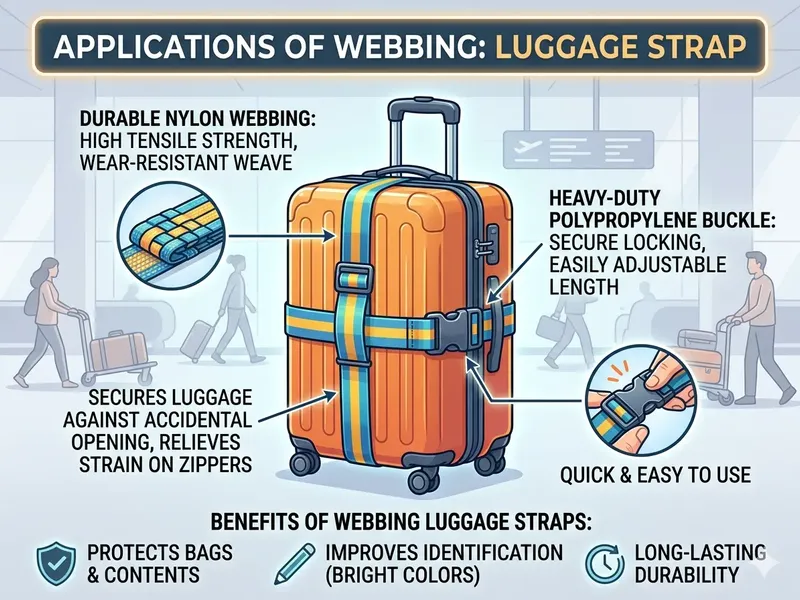
Application Image
Luggage Strap
Application Overview
3 products available for this application.
Luggage Strap Products
Explore our webbing products engineered for luggage strap applications. Click any product for detailed technical specifications.
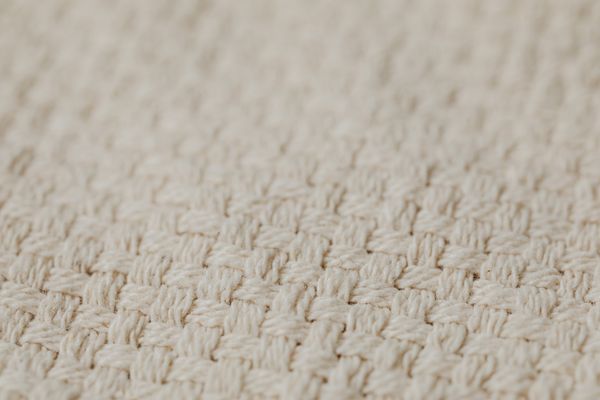 Lightweight PPW-LG-004
 Luggage Polypropylene Webbing
Durable polypropylene webbing for luggage straps, bag handles and travel accessories.
Decorative Pattern CW-HB-003 Herringbone Cotton Webbing
Premium herringbone cotton webbing featuring a decorative woven pattern and superior durability.
Excellent NW-TB-002 Tubular Nylon Webbing
Premium tubular nylon webbing designed for climbing, rescue and fall protection equipment.
Technical Details
Detailed description and specifications for Luggage Strap.
Overview
Luggage straps are external or internal securing components used to compress, stabilize, and reinforce suitcases, travel bags, duffels, and cargo containers during handling and transit. The webbing forms the structural backbone of the strap, bearing tension loads while resisting the repeated stress of buckling, cinching, and rough baggage handling. Because a failed strap can result in lost contents or damaged luggage, the webbing must combine high tensile strength, minimal elongation under load, and durable resistance to abrasion, moisture, and UV exposure across varied travel environments.
Key Requirements & Specifications
- Tensile (breaking) strength: 500 to 1,800 lbs (2.2 to 8.0 kN) for standard consumer luggage straps; heavy-duty cargo and cross-body reinforcement straps range from 3,000 to 8,000 lbs (13.3 to 35.6 kN) where webbing doubles as a load-securing member.
- Width: 25mm (1 inch) is the industry standard for adjustable luggage straps; 38mm (1.5 inch) and 50mm (2 inch) are common for wider compression and heavy-duty applications. Narrow accessory straps run 20mm.
- Thickness: 1.2mm to 2.0mm depending on fiber and weave density. Higher thickness improves buckle grip and abrasion life but adds bulk and weight.
- Elongation at break: kept below 20 to 25 percent for polyester and nylon constructions; low-stretch polyester is preferred where the strap must hold compression without loosening in transit.
- Abrasion resistance: rated for 10,000+ cycles under standard Martindale or equivalent testing, critical for straps dragged across conveyor systems and hard surfaces.
- UV resistance: solution-dyed or UV-stabilized fibers retaining 80 percent or more of tensile strength after 500 hours of accelerated weathering, relevant for straps exposed to sunlight during outdoor and airport handling.
- Moisture and mildew resistance: low water absorption (polypropylene under 0.1 percent, polyester under 0.4 percent) to prevent weight gain, rot, and odor in humid or wet conditions.
- Operating temperature range: -30°C to +80°C for polyester and nylon; polypropylene maintains stability from -20°C to +70°C, adequate for cargo holds and tropical climates.
- Colorfastness: Grade 4 to 5 on the gray scale for wash and rubbing, ensuring printed logos and dyed colors do not transfer or fade.
Recommended Webbing Solutions
Luggage Polypropylene Webbing: A cost-effective, lightweight option with near-zero water absorption and good chemical resistance, making it well suited to high-volume consumer luggage straps where moderate strength (500 to 1,200 lbs) and low cost are priorities. Its natural resistance to mildew and moisture makes it reliable in humid shipping and storage conditions.
Heavy Duty Polyester Webbing: The preferred choice for straps requiring low stretch and high breaking strength, with tensile ratings up to 8,000 lbs in dense weaves. Polyester holds compression without loosening, resists UV degradation, and retains dimensional stability across a wide temperature range, making it ideal for premium and heavy-duty luggage straps.
Tubular Nylon Webbing: Offers superior abrasion resistance and a softer hand with higher elongation, useful for straps that must absorb shock loads and flex repeatedly without cracking. Nylon's toughness suits reinforcement handles and load-bearing straps on duffels and expedition bags, though it absorbs more moisture than polyester.
Herringbone Cotton Webbing: A natural-fiber option for heritage, fashion, or eco-oriented luggage lines where appearance and soft texture matter more than maximum load capacity. The herringbone weave provides a decorative surface and good grip, best applied to lightweight garment bags and accessory straps rather than high-tension securing.
Applications & Use Cases
- External compression straps: Wrapped around hard-shell and soft-shell suitcases to prevent accidental opening and to compress contents, these rely on low-stretch polyester at 25mm to 50mm width so the strap holds tension throughout a journey without slackening.
- Cross-body and shoulder carry straps: Load-bearing straps on duffels and travel bags where 38mm to 50mm nylon or polyester distributes weight and withstands repeated flexing, buckling, and abrasion against clothing and surfaces.
- Cargo and airline handling reinforcement: Heavy-duty polyester straps rated 3,000 lbs and above used to secure oversized or grouped baggage, providing a load-securing member that survives conveyor and forklift handling.
- Internal packing straps: Sewn inside suitcases to hold folded clothing in place, typically 20mm to 25mm polypropylene or polyester chosen for light weight, low bulk, and moisture resistance.
- Identification and branded luggage straps: Consumer straps printed with logos, names, or colors for airport visibility and brand differentiation, requiring high colorfastness and clean printable surfaces on polyester or polypropylene.
- Expedition and outdoor gear straps: Reinforcement and lashing straps on trekking and expedition luggage exposed to sun, rain, and rough terrain, demanding UV-stabilized, abrasion-resistant nylon or polyester with stable performance from -30°C to +80°C.
Customization & Wholesale
Minimum order quantity: standard MOQ is 500 meters per color and specification for stock constructions; custom-woven or specialty specifications typically start at 3,000 meters. Trial and sample orders can be arranged in smaller lots subject to negotiation.
Custom widths: available from 10mm to 100mm, with 20mm, 25mm, 38mm, and 50mm held as common production widths for luggage strap applications. Non-standard widths can be woven to order.
Custom colors: dyeing to Pantone or customer-supplied color standards, with solution-dyed options available for maximum UV and wash fastness. Standard stock colors include black, navy, gray, red, and khaki.
Custom printing and branding: single and multi-color logo printing, jacquard-woven text and patterns, silicone or heat-transfer printing, and repeating brand motifs along the strap length. Woven-in branding is recommended for durability where printed surfaces would wear.
OEM and ODM: full private-label manufacturing including custom weave density, edge finishing, fiber blends, and packaging. Technical drawings and target specifications can be matched to defined tensile, width, and elongation requirements.
Tensile and quality customization: breaking strength engineered to buyer specification within fiber limits, from 500 lbs consumer grade to 8,000 lbs heavy-duty, with test reports provided on request.
Lead time: 7 to 15 days for stock specifications and colors; 20 to 35 days for custom-woven, custom-dyed, or printed orders depending on quantity and finishing. Sampling lead time is typically 5 to 10 days.
Export capabilities: established export operations serving North America, Europe, Southeast Asia, the Middle East, and South America. Standard export packaging on rolls or spools, palletized for container shipping, with FOB, CIF, and EXW terms supported. Documentation includes commercial invoice, packing list, certificate of origin, and material test and compliance reports as required. Compliance with OEKO-TEX, REACH, and Prop 65 standards available on request for regulated markets.
Need Luggage Strap Solutions?
Our engineering team can develop custom webbing solutions for your specific luggage strap requirements.
Request a Technical Quote