Safety Harness
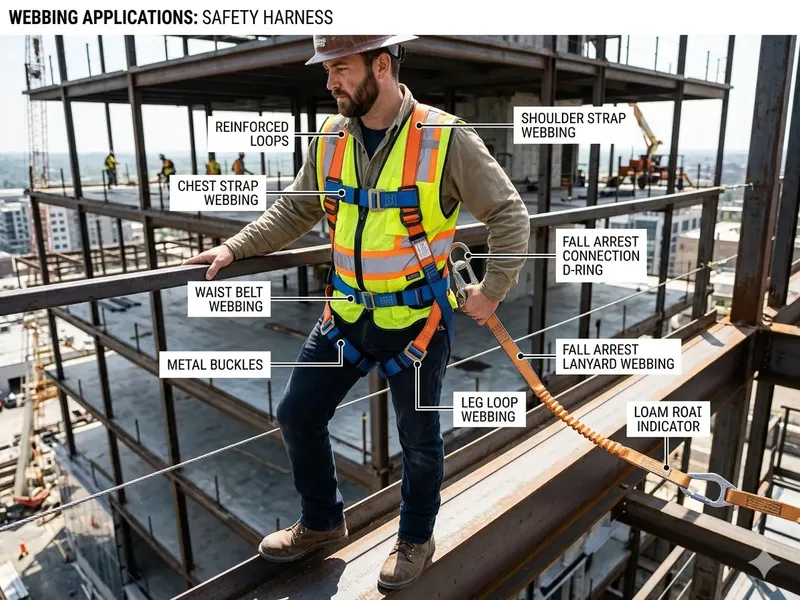
Application Image
Safety Harness
Application Overview
3 products available for this application.
Safety Harness Products
Explore our webbing products engineered for safety harness applications. Click any product for detailed technical specifications.
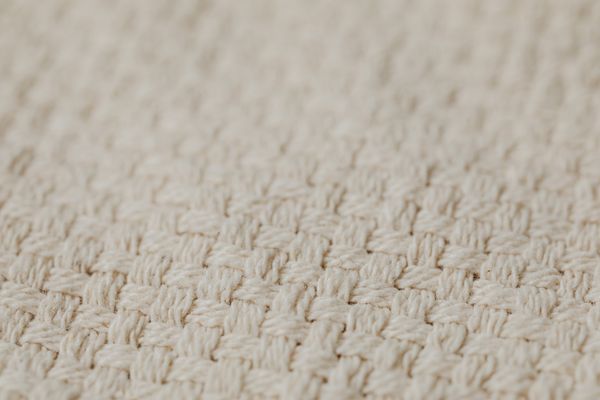 High Reliability UW-SH-004
 UHMWPE Safety Harness Webbing
High-performance UHMWPE webbing engineered for fall protection and safety harness systems.
Professional Grade AW-SH-005 Aramid Safety Harness Webbing
Professional aramid webbing developed for high-temperature safety harness systems.
Heavy Duty NW-HD-004 Heavy Duty Nylon Webbing
High-strength nylon webbing designed for industrial lifting, safety equipment and outdoor applications.
Technical Details
Detailed description and specifications for Safety Harness.
Overview
Safety harness webbing is a load-bearing textile component engineered for fall-protection and personal restraint systems used in construction, industrial maintenance, tower work, and rescue operations. As a primary structural element of Class E and full-body harnesses, the webbing must arrest a falling worker while distributing impact forces across the body without failure or excessive elongation. Because the webbing directly determines the harness's certified breaking strength, energy absorption, and service life, material selection and manufacturing tolerances are subject to strict PPE standards including ANSI Z359, EN 361, and OSHA 1926.502.
Key Requirements & Specifications
- Minimum breaking strength: 4,000 to 8,000 lbs (18 kN to 36 kN) for primary load-bearing webbing, with 22.2 kN (5,000 lbs) being the common ANSI Z359.11 benchmark for harness structural elements.
- Standard width: 44mm to 45mm (1.75 inches) for shoulder and leg straps; 25mm and 38mm variants are used for sub-straps, positioning, and secondary connections.
- Thickness: 1.8mm to 3.0mm depending on material and ply construction, balancing strength against buckle compatibility and comfort.
- Elongation at break: controlled to 10% to 20% for nylon; UHMWPE and aramid webbing exhibit low elongation of 3% to 5%, providing minimal stretch under shock load.
- UV resistance: retention of at least 80% breaking strength after 500 hours of accelerated UV exposure (per ISO 4892 / QUV testing), critical for harnesses used in prolonged outdoor exposure.
- Abrasion resistance: minimum 25,000 to 50,000 cycles under Martindale or equivalent testing, protecting against edge wear and contact with structural steel.
- Operating temperature range: -40°C to +80°C for nylon and UHMWPE; aramid variants tolerate continuous exposure up to +200°C with short-term resistance beyond +400°C.
- Weight/areal density: typical range 40 to 70 g/m for standard nylon harness webbing, with UHMWPE offering equivalent strength at reduced weight.
Recommended Webbing Solutions
UHMWPE Webbing (UHMWPE Safety Harness Webbing): Ultra-high-molecular-weight polyethylene delivers one of the highest strength-to-weight ratios available, allowing thin, lightweight webbing that still meets or exceeds 22 kN breaking strength. It suits harnesses where reduced weight and low elongation improve wearer mobility and fall-arrest performance, and its inherent moisture and chemical resistance extends service life in wet or corrosive environments.
Aramid Webbing (Aramid Safety Harness Webbing): Aramid fiber provides exceptional heat and flame resistance alongside high tensile strength, making it the correct choice for harnesses used near welding, foundry work, electrical utilities, and firefighting. It maintains structural integrity at temperatures where nylon and polyester would soften or melt, though it requires UV-protective treatment or coverings due to aramid's natural sensitivity to sunlight.
Nylon Webbing (Heavy Duty Nylon Webbing): Heavy-duty nylon offers a proven balance of high breaking strength, controlled elongation, and shock-absorbing capacity, which is advantageous for energy dissipation during fall arrest. Its abrasion resistance and cost efficiency make it the standard workhorse material for general-purpose full-body harnesses across construction and industrial sectors.
Seat Belt Nylon Webbing: This tightly woven, high-tenacity nylon construction is engineered for consistent, repeatable breaking strength and smooth buckle feed, making it well suited to positioning straps, sub-pelvic support, and restraint sections of a harness where dimensional stability and surface smoothness are priorities.
Applications & Use Cases
- Construction fall protection: Full-body harnesses on steel erection, scaffolding, and high-rise concrete work, where webbing must arrest falls of up to 1.8m free-fall distance and withstand repeated daily donning and jobsite abrasion.
- Tower and telecom climbing: Harnesses for cell tower, transmission line, and wind turbine technicians requiring high UV stability and low elongation for extended outdoor and at-height positioning.
- Industrial maintenance and confined space: Restraint and retrieval harnesses in refineries, tanks, silos, and utility vaults where chemical exposure and edge abrasion demand durable UHMWPE or coated nylon webbing.
- Rescue and rope access: Technical rescue and IRATA/SPRAT rope-access harnesses needing high breaking strength, low stretch, and reliable performance under dynamic loading.
- Hot-work and utility environments: Aramid webbing harnesses for welders, foundry operators, and electrical linemen exposed to sparks, arc-flash risk, and elevated ambient heat.
- Transportation and equipment restraint: Seat belt nylon webbing adapted for operator restraint systems, positioning belts, and secondary tie-off applications where smooth buckle interaction and stable width are required.
Customization & Wholesale
Minimum order quantity: 500m per specification for standard in-stock constructions; custom-engineered webbing typically starts at 3,000m to 5,000m per width and color to justify dedicated loom setup. Sampling quantities of 50m to 100m are available for qualification and testing prior to bulk commitment.
Custom widths: Available from 20mm through 50mm on standard needle and shuttle looms, with common production widths of 25mm, 38mm, 44mm, and 45mm. Non-standard widths can be tooled to buyer specification.
Colors and printing: Solid-dyed webbing available across standard and Pantone-matched colors, with high-visibility safety yellow, orange, and reflective-tracer options for compliance and brand differentiation. Custom logo printing, repeating text (load ratings, brand name, batch codes), and woven-in jacquard identification are supported for OEM programs.
Construction and finishing: Options include single-ply and multi-ply woven structures, edge-sealed or heat-cut ends, silicone or PU coatings for enhanced abrasion and moisture resistance, and UV-stabilizing treatments for aramid and outdoor-service webbing.
OEM and private label: Full OEM/ODM support including material selection guidance, breaking-strength engineering to target ANSI/EN thresholds, custom selvage marking, and private-label packaging. Third-party test reports (breaking strength, elongation, UV, abrasion) can be provided to support buyer certification programs.
Lead time: Standard stock items ship within 7 to 15 days; custom-woven, dyed, or printed orders typically require 20 to 35 days depending on quantity, color count, and finishing. High-volume contract orders can be scheduled against a rolling production plan.
Export capabilities: Direct export to North America, Europe, Southeast Asia, the Middle East, Australia, and South America. Standard packaging is on cardboard cores in rolls of 100m to 500m, cartoned and palletized for container shipment. FOB, CIF, and EXW terms are supported, with documentation including commercial invoice, packing list, certificate of origin, and applicable test certificates. Container-load pricing and consolidated LCL shipments are both accommodated for wholesale buyers.
Need Safety Harness Solutions?
Our engineering team can develop custom webbing solutions for your specific safety harness requirements.
Request a Technical Quote