Marine Industry
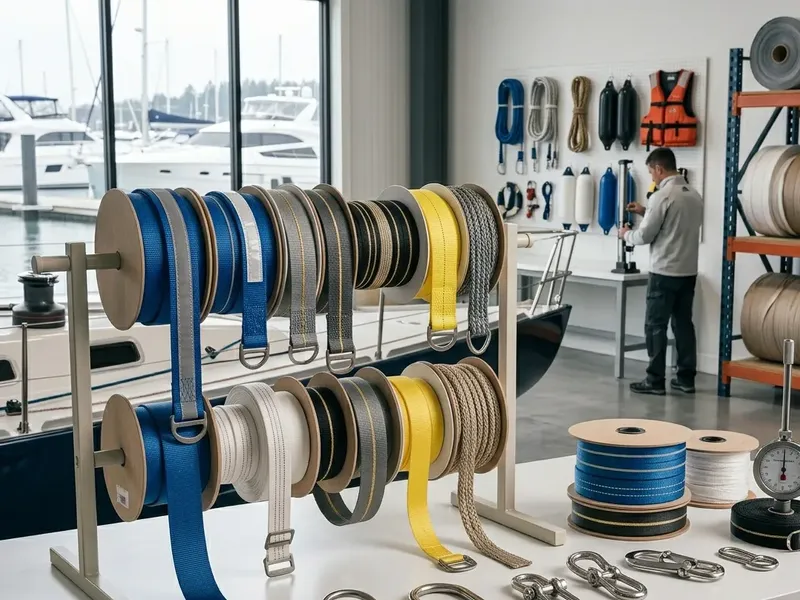
Industry Image
Marine Industry
Marine Industry Products
Explore our webbing products engineered for the marine industry industry. Click any product for detailed technical specifications.
 Superior UW-MR-005
 UHMWPE Marine Webbing
Corrosion-resistant UHMWPE webbing designed for marine and offshore applications.
Excellent PPW-MR-003 Marine Polypropylene Webbing
Water-resistant polypropylene webbing engineered for marine and boating applications.
Industry Details
Detailed description and technical context for Marine Industry.
Overview
The marine industry encompasses commercial shipping, offshore energy, fishing fleets, recreational boating, aquaculture, and port operations, representing a global market valued in the trillions of dollars with steady annual growth driven by seaborne trade, which carries roughly 80 percent of world merchandise by volume. Webbing plays a critical structural and safety role across this sector, serving in mooring lines, rigging, lifting slings, lashings, safety harnesses, and cargo restraint where failure carries severe cost and safety consequences. Because marine environments combine continuous saltwater exposure, intense ultraviolet radiation, mechanical abrasion, and cyclic loading, webbing selected for this industry must meet substantially higher durability and strength thresholds than general-purpose textile webbing.
Key Requirements & Specifications
- Tensile/breaking strength: Marine load-bearing webbing typically ranges from 3,000 lbs (13.3 kN) for light rigging and lashing up to 20,000 lbs (89 kN) or higher for heavy lifting slings and mooring assemblies. A standard 50mm UHMWPE marine sling web commonly delivers 10,000 to 15,000 lbs (44 to 67 kN) minimum breaking strength.
- Width range: Standard marine webbing is produced from 20mm through 100mm, with the most common structural widths being 25mm, 50mm, and 75mm. Narrower 20mm to 38mm widths serve rigging and tie-downs; 50mm to 100mm widths serve lifting and mooring.
- Thickness: Typically 1.8mm to 4.0mm depending on width and denier, with heavy sling web reaching 3.5mm to 4.0mm for abrasion life and load distribution.
- UV resistance: Webbing should retain at least 80 to 85 percent of original tensile strength after 500 hours of accelerated UV/QUV exposure, with UV-stabilized yarns recommended for continuous outdoor and above-deck use.
- Abrasion resistance: UHMWPE constructions offer abrasion resistance up to 10 to 15 times greater than polyester or nylon of equal weight, a key factor for mooring lines running through chocks and fairleads.
- Chemical and saltwater resistance: Marine webbing must resist saltwater, hydrocarbons, mild acids, and alkalis with negligible strength loss; UHMWPE and polypropylene both offer near-zero water absorption, unlike nylon which can lose 10 to 15 percent strength when wet.
- Temperature range: Operational range of approximately minus 40 degrees C to plus 70 degrees C for UHMWPE and minus 20 degrees C to plus 80 degrees C for polypropylene, covering most marine deck and offshore conditions.
- Buoyancy and elongation: Polypropylene and UHMWPE both float, with specific gravity below 1.0, and offer low elongation (UHMWPE elongation at break is typically 3 to 4 percent), which is critical for controlled load handling and positive mooring behavior.
Recommended Webbing Solutions
UHMWPE Marine Webbing (UHMWPE Webbing category): Ultra-high-molecular-weight polyethylene webbing offers the highest strength-to-weight ratio in this category, with exceptional abrasion and cut resistance and near-zero water absorption. It is the preferred choice for high-load mooring and rigging where low elongation, floating capability, and long service life under continuous saltwater and UV exposure are required.
Marine Polypropylene Webbing (Polypropylene Webbing category): Polypropylene webbing is a cost-effective, lightweight, buoyant solution that resists saltwater, mildew, and most chemicals without water absorption. It suits general-purpose marine rigging, lashings, cargo restraint, and applications where floating and corrosion resistance matter more than maximum tensile strength, making it a practical bulk option for wholesale buyers.
UHMWPE Lifting Sling Webbing (UHMWPE Webbing category): Engineered specifically for lifting and load-bearing applications, this webbing combines very high breaking strength with abrasion resistance and dimensional stability under repeated loading. It is well suited to marine crane slings, offshore lifting operations, and heavy deck handling where a high safety factor and compact, low-stretch construction are essential.
Industry Applications
- Mooring and docking lines: UHMWPE and polypropylene webbing used to secure vessels to docks, buoys, and other vessels, where saltwater resistance, low elongation, and abrasion resistance against fairleads and chocks determine service life.
- Marine lifting slings: UHMWPE lifting sling webbing deployed for hoisting engines, containers, nets, and equipment on deck and offshore, requiring high breaking strength and a certified safety factor, commonly 7:1 for lifting applications.
- Rigging and standing/running rigging support: Narrow to mid-width webbing used in sail control, load straps, and rigging assemblies on commercial and recreational vessels, benefiting from low stretch and UV stability above deck.
- Cargo lashing and restraint: Polypropylene and polyester-blend webbing used to secure deck cargo, containers, and equipment against vessel motion, requiring consistent breaking strength and resistance to wet conditions.
- Aquaculture and fishing operations: Webbing used in net attachment, cage mooring, and trawl rigging, where continuous submersion, biofouling exposure, and abrasion demand high-durability UHMWPE or polypropylene constructions.
- Safety and rescue equipment: Webbing integrated into life jackets, safety harnesses, jackstays, and man-overboard systems, where UV retention, wet strength, and consistent load ratings are safety-critical.
Customization & Wholesale
WebbingMaker supplies marine webbing to global wholesale and bulk buyers with a standard minimum order quantity of 500m per specification, with lower sample quantities available for qualification and testing. Custom widths are produced across the full 20mm to 100mm range, with tailored thickness, denier, and weave density to meet specific breaking-strength targets.
Color options include full custom dyeing with standard marine colors such as black, white, blue, orange, and high-visibility yellow, with solution-dyed and UV-stabilized options for extended outdoor life. Custom printing and OEM branding are available, including logo printing, load-rating markings, batch identification, and center-line tracer threads for lifting-sling identification and traceability.
OEM and ODM services cover custom construction development, private-label packaging, and specification matching to buyer or classification-society requirements. Standard production lead time is 15 to 25 days depending on order volume, dyeing, and printing requirements, with sample lead time of 5 to 7 days. Larger contract volumes and repeat orders can be scheduled under blanket purchase agreements to shorten effective lead times.
Export capabilities include worldwide shipping via FOB, CIF, and EXW terms from major Chinese ports, with support for full container load and less-than-container-load consignments. Documentation support covers test certificates, breaking-strength reports, material declarations, and compliance documentation required for marine and lifting applications, along with export packing standards suited to long-haul ocean freight.
Need Marine Industry Solutions?
Our engineering team understands the unique compliance and performance requirements of the marine industry sector.
Request a Technical Quote